Fort Worth properties built over heavy clay soils face unique structural vulnerabilities from native subterranean termites seeking moisture during extended summer droughts. In historic crawlspace foundations throughout…
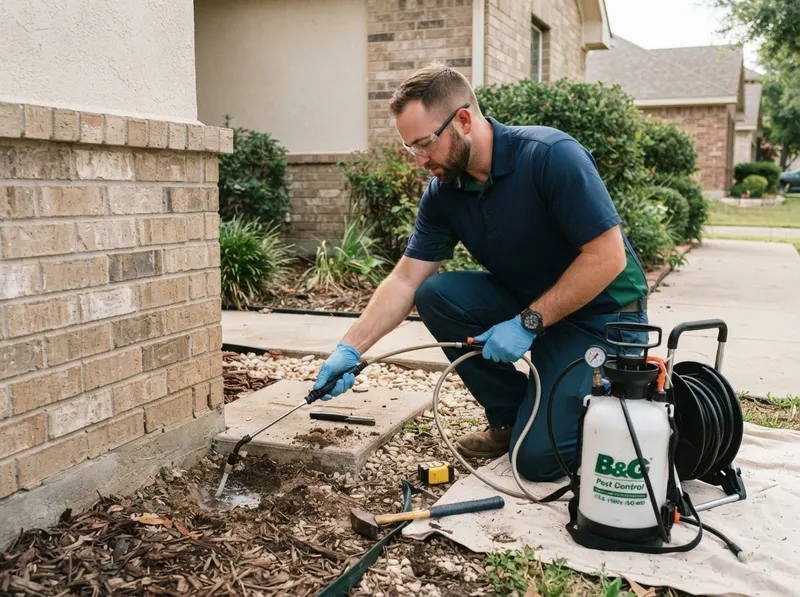
Fort Worth properties built over heavy clay soils face unique structural vulnerabilities from native subterranean termites seeking moisture during extended summer droughts. In historic crawlspace foundations throughout Fairmount and Arlington Heights, settling perimeter soil often pulls away from brick piers, forming micro-gaps where termites erect earthen mud tubes directly onto structural sills. Modern post-tension slab homes across Heritage, Summerfields, and Overton Park experience termite ingress through hidden expansion joints, bath traps, and perimeter weep screeds. An effective defense requires saturating the immediate foundation trench with non-repellent termiticide, allowing foraging workers to unknowingly walk through the treated perimeter, transfer the active agent back to the subterranean nest, and neutralize the reproductive queen without broadcasting airborne odors inside family living areas.
Selecting between a continuous perimeter soil treatment and stand-alone bait station networks depends on exterior architecture, yard hardscaping, and soil stability. Liquid soil applications suit properties with clear dirt perimeter beds, such as traditional front elevations in Tanglewood and TCU-Westcliff, establishing an impenetrable 5-year chemical barrier around the envelope. In scenarios where extensive flagstone patios, decorative concrete, or mature oak roots border the foundation near Ridglea Hills or Lake Worth, trenching is combined with drilled concrete injection ports every 12 inches to maintain perimeter continuity. Ground-level bait monitoring stations serve as an ideal complementary layer or standalone option for zero-disruption inspection, utilizing compressed cellulose cartridges to detect early activity before wood framing is damaged. The primary trade-off rests in immediate exclusion versus long-term surveillance: liquid trenching instantly protects structural entry points, whereas monitoring stations track colony pressure changes across quarterly inspection cycles.
1. Technicians measure perimeter linear footage, identify plumbing penetrations, and scrape structural wood framing to determine if activity is isolated or widespread.
2. A narrow 6-inch wide by 6-inch deep trench is excavated flush against exterior stem walls, followed by pressure-injected chemical dispersion down to the top of the footing.
3. Concrete pads abutting exterior walls are diamond-drilled at 12-inch intervals to inject termiticide directly beneath slabs, after which holes are sealed flush with hydraulic cement.
4. Tamper-resistant bait monitoring stations are driven into soil beds every 10 to 15 feet around the yard perimeter for continuous, kid-and-pet-safe perimeter surveillance.
Every job gets a firm, written price after a free on-site visit.
Tell us about your subterranean termite soil treatment and monitoring job in Fort Worth and we'll send a clear, written quote, usually the same day.
 HomeShielders Pest Control