Red imported fire ants present a persistent physical hazard in North Texas, where summer heat and native clay soils force colonies deep into turf root systems and foundation perimeters. In neighborhoods like…
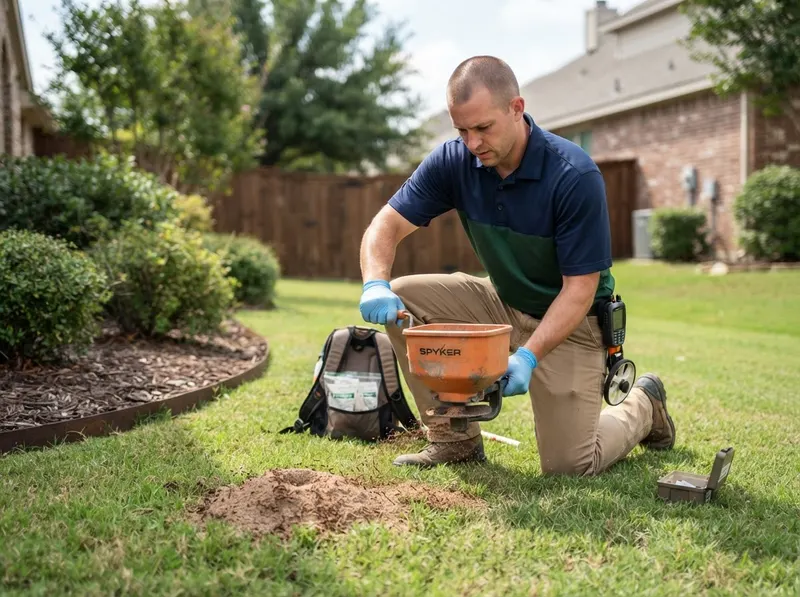
Red imported fire ants present a persistent physical hazard in North Texas, where summer heat and native clay soils force colonies deep into turf root systems and foundation perimeters. In neighborhoods like Tanglewood, Overton Park, and Ridglea Hills, mature riverfront canopies and residential irrigation provide continuous moisture, creating conditions where colonies establish interconnected satellite mounds overnight. Standard retail liquid sprays act merely as surface repellents; when sprayed superficially, workers relocate the reproductive queen deeper into the subsoil, fragmenting one mound into several. Professional turf management relies on systematic insect growth regulators (IGRs) distributed via calibrated broadcast spreaders across the entire turf footprint. Foraging workers carry the lipid-coated bait directly to the queen within 48 to 72 hours, stopping egg viability at the biological source without introducing volatile surface residues.
Properties bordering natural zones or lake areas, such as Lake Worth, Oakhurst, and Heritage, frequently face reinvasion from untamed fence lines and municipal easements. A proper exclusion strategy addresses both visible outdoor spaces and sub-grade pathways near structural footings. Technicians establish a continuous defense band extending 3 feet up the exterior masonry and 5 feet outward into the adjacent turf, preventing workers from accessing wall voids and outdoor electrical conduits, a common occurrence around AC condensers and irrigation controllers in Fairmount and TCU-Westcliff. The materials selected bind tightly to organic matter in the soil, preventing chemical runoff into local watersheds like the Trinity River during seasonal cloudbursts.
Decision guidance depends strictly on property usage and immediate safety needs. If an active mound directly threatens play areas, outdoor dining spaces, or pet runs, direct mound injection with a localized non-repellent liquid provides colony neutralization within hours. For general season-long yard defense, whole-yard broadcast baiting functions as the foundation; while broad baiting takes 10 to 21 days to fully collapse an entire underground colony network, it delivers 6 to 12 months of residual suppression. Combining broadcast baiting with targeted mound injection resolves immediate sting risks while halting future colonization, establishing an impenetrable barrier across your landscape.
Every job gets a firm, written price after a free on-site visit.
Tell us about your imported fire ant turf management job in Fort Worth and we'll send a clear, written quote, usually the same day.
 HomeShielders Pest Control