Quarterly perimeter pest barrier maintenance stops structural intruders at the building envelope rather than relying on broadcast chemical saturations inside family living rooms. In regions like Fort Worth, shifting…
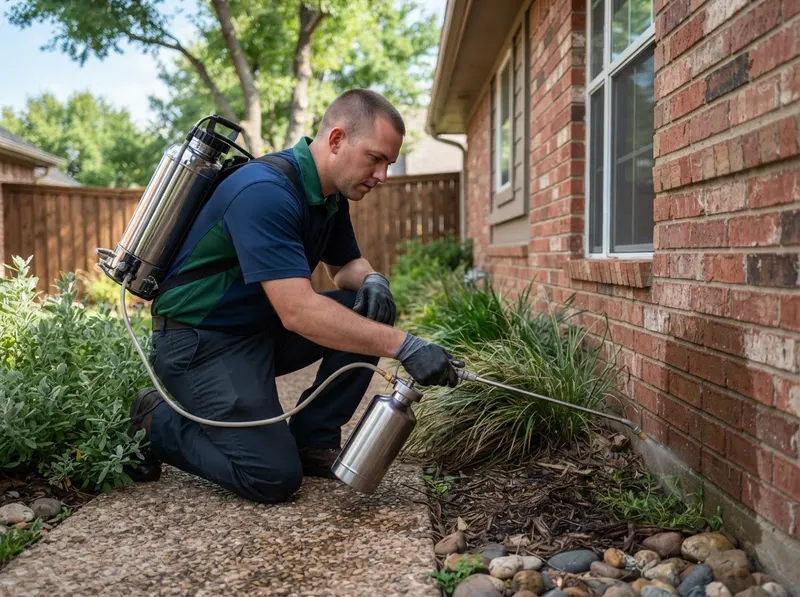
Quarterly perimeter pest barrier maintenance stops structural intruders at the building envelope rather than relying on broadcast chemical saturations inside family living rooms. In regions like Fort Worth, shifting clay soils create persistent perimeter fractures where utility conduits and expansion joints meet masonry. A quarterly defense protocol installs micro-encapsulated exterior barriers up to three feet up the exterior wall and three feet outward across surrounding grade. This application repels invasive insects seeking moisture during dry North Texas summers or warmth during cold Northers. Specialized dust formulations are placed inside structural weep holes and soffits, creating an impenetrable biological buffer that operates quietly outdoors without introducing chemical aromas near children or pets.
Neighborhoods with mature tree canopies and aging brick foundations, such as Fairmount, Tanglewood, and Arlington Heights, face relentless pressure from wood roaches, acrobat ants, and brown recluse spiders traversing foundation mortar. Meanwhile, newer subdivisions in Heritage and Summerfields experience sudden ground-pest displaced migrations following commercial earth grading. Exterior maintenance resolves this friction by targeting the specific transit lanes pests use: plumbing penetrations, brick veneer ledges, and door thresholds. Unlike reactive interior spot-treatments that only target isolated scouts, scheduled exterior applications intercept migrating colonies before nesting sites establish within crawlspaces or wall cavities.
Decision guidance depends directly on property architecture and previous pest pressure. For historic pier-and-beam bungalows in TCU-Westcliff or Ridglea Hills, a combined crawlspace barrier plus exterior perimeter maintenance provides necessary structural isolation; a pure perimeter barrier alone cannot block subterranean moisture vectors if skirting vents remain unmeshed. Conversely, slab-on-grade homes in Overton Park and Oakhurst benefit completely from seasonal exterior perimeter maintenance, avoiding all interior disruption. The trade-off between standard bi-monthly treatments and quarterly maintenance centers on product persistence: modern micro-encapsulated polymers maintain chemical integrity for 90 days under Texas UV exposure, providing uninterrupted exclusion while minimizing unnecessary service disruptions on private property.
Every job gets a firm, written price after a free on-site visit.
Tell us about your quarterly perimeter pest barrier maintenance job in Fort Worth and we'll send a clear, written quote, usually the same day.
 HomeShielders Pest Control