Stinging insect and paper wasp colony removal addresses territorial aerial colonies before workers establish structural access into attic insulation or exterior wall cavities. In older Fort Worth residential…
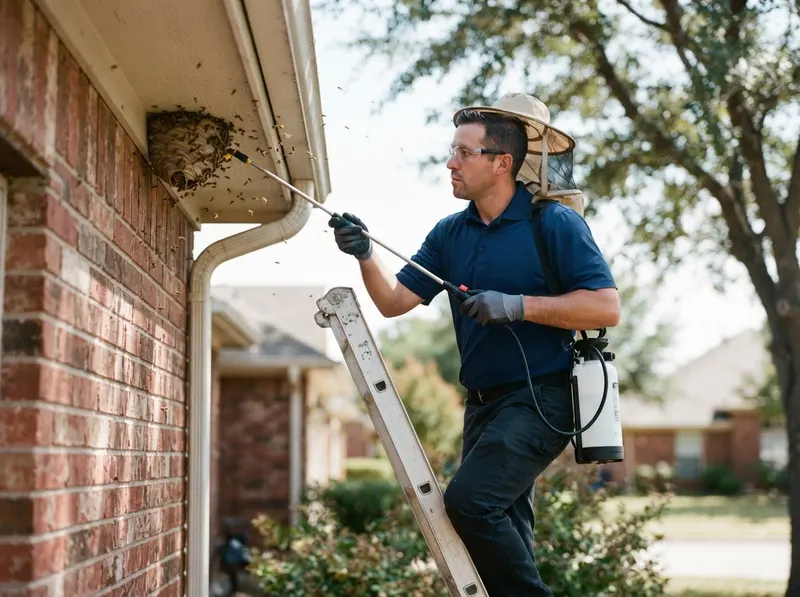
Stinging insect and paper wasp colony removal addresses territorial aerial colonies before workers establish structural access into attic insulation or exterior wall cavities. In older Fort Worth residential neighborhoods such as Fairmount, Arlington Heights, and Tanglewood, broad open fascia boards, exposed porch ceilings, and vented soffits offer prime nesting sites for Polistes metricus and red paper wasps. Left untreated, colonies expand from single foundress nests to populations exceeding 30 aggressive workers by midsummer. Elimination requires localized botanical or pyrethroid freeze treatments applied directly to the comb face to incapacitate workers instantly, followed by manual scrapers to detach the pedicle stalk cleanly from exterior brick, vinyl, or wood substrates. Chemical application uses targeted micro-droplets rather than broad broadcast sprays, keeping outdoor entertaining spaces and children's play equipment free from drifting chemical residues.
Paper wasps differ substantially from ground-nesting yellowjackets or honeybee swarms, dictating separate structural methods. Paper wasps construct single-tier, open-celled umbrella nests suspended beneath overhangs, horizontal tree branches, or window headers. If a colony enters behind brick weep holes or rotted soffits in TCU-Westcliff, Ridglea Hills, or Overton Park, standard surface knockdown proves ineffective; structural voids instead require non-repellent dust injection directly into the entry seam. The trade-off between exterior nest scraping and full void dusting involves labor time and material penetration: simple open-eave nests take less than an hour, whereas concealed wall-void infestations require mechanical tracking of worker flight paths, ladder work up to 25 feet, and subsequent exterior void caulking to seal off re-entry paths.
Environmental conditions along Lake Worth, the West Fork Trinity River, and northern tracts like Summerfields and Heritage accelerate seasonal nest production. Natural riparian water sources provide abundant moisture for wasps processing raw wood pulp into nest carton material. Technicians establish protective perimeters by treating primary contact points with water-resistant micro-encapsulated formulations that adhere to brick veneer and cedar shakes for 60 to 90 days. Numbered extraction procedures follow a predictable sequence: 1. Confirm flight velocity and pinpoint active nest chambers without shaking the mounting substrate. 2. Apply targeted freeze knockdown agents directly into the brood comb. 3. Physically bag and detach the structural nest base to eliminate pheromone markers. 4. Seal local entry crevices measuring one-quarter inch or larger with copper mesh or silicone sealant.
Every job gets a firm, written price after a free on-site visit.
Tell us about your stinging insect and paper wasp colony removal job in Fort Worth and we'll send a clear, written quote, usually the same day.
 HomeShielders Pest Control